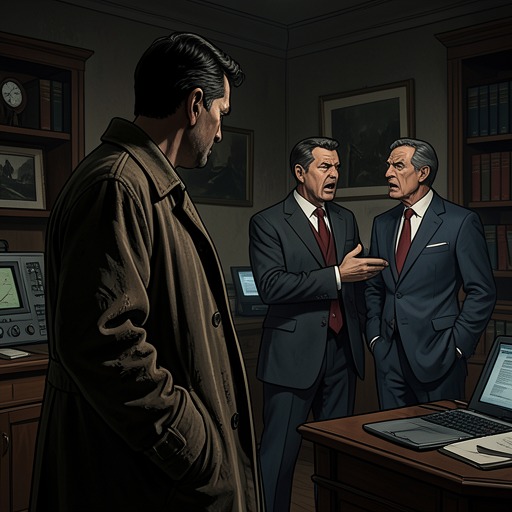
Reconstruction in Texas
News of the WorldReconstruction in Texas shapes the novel as a collision between formal power and the people left to navigate its gaps. Governor Davis and the United States Army appear in a landscape where local government has been dismantled but not replaced, while frontier travel remains exposed to military patrols, raiding, and contested authority. These conditions reach beyond politics: they govern what Jefferson Kyle Kidd can safely read aloud, how he transports Johanna Leonberger, and what legal claims can be made about her future.
Government and the Local Power Vacuum
In Erath County, a self-appointed group explains the absence of ordinary local government to Jefferson Kyle Kidd. There is no sheriff, justice of the peace, mayor, or board of commissioners: Davis’s men have removed the previous officeholders, many of whom served the Confederacy, and have not sent replacements. The group says that it has taken on the job and holds Kidd accountable. Its assertion does not restore an agreed civic order; instead, it shows how readily a vacuum can be filled by people whose authority rests on their own claim to act.
The episode gives political instability a direct consequence for travelers. Kidd and Johanna encounter not a functioning local administration but men who can stop them and demand an answer. The novel presents Reconstruction’s power not simply as something exercised by distant officials or soldiers, but as something improvised on the road, where local self-appointment can become coercive.
Frontier Movement and Overlapping Authority
The effort to return Johanna to her relatives depends on a chain of intermediaries. An Indian Agent has information about the raid in which her parents and little sister were killed, a paper from her aunt and uncle Wilhelm and Anna Leonberger, and a fifty-dollar gold piece sent by the family. A major from San Antonio, Texas, carried the money north; the Agent sought someone to transport Johanna home. Britt Johnson undertook to get her out of Indian Territory north of the Red River and across the river, whose waters had risen sharply. The crossing was so dangerous that the travelers nearly drowned.
Military authority enters this journey in the form of a mounted United States Army patrol. When about ten soldiers come into view, Kidd checks and conceals his weapons, then signals to Johanna that they are friends and lifts her into the wagon. The encounter makes the journey’s vulnerability tangible: a child’s return is mediated by family instructions and an Agent’s payment, yet the presence of soldiers can change the immediate stakes of the road. The frontier is also exposed to violence beyond government control. As Kidd enters the hill country, he watches for Comanche raiding parties, whose routes take advantage of concealment, water, and isolated farms where soldiers are absent.
Newspapers, Readings, and Political Constraint
The period also shapes Kidd’s work as a traveling newspaper reader. In Durand, he selects less contentious material than he had read in Dallas. He turns to reports of floods along the Susquehanna, railroad bonds in Illinois, and familiar publications including the London Times, the New-York Evening Post, Harper’s Weekly, and Household Words. He avoids material about Hamilton, Governor Davis, Black suffrage in Texas, military occupation, and the Peace Policy. The selection is practical: in a contentious setting, what he chooses to read aloud can matter as much as the news he carries.
The novel contrasts this caution with the uneven circulation of news across the state. The larger cities receive daily papers brought by boats at Galveston and Indianola or by train from St. Louis. Kidd’s readings attract audiences instead in smaller northern and western towns, including Dallas and Fort McKavett, near the frontier. Newspapers and railways carry the signs of expanding communication, even as children are taken in Comanche and Kiowa raids and raiding parties remain a threat. Progress does not erase danger or make information equally accessible; the frontier’s distance from the larger cities helps sustain Kidd’s work while also exposing its limits.
Law, Captivity, and the Possibility of Change
The legal order remains uncertain even in San Antonio, Texas. Kidd consults the lawyer Branholme about adoption, the status of returned captives, and the Printing Bill. Branholme suggests that the bill might be rescinded after Governor Davis leaves and the military no longer holds power, making it possible for Kidd to resume his business. On the question of captives, he says they belong to their parents or guardians. That legal statement leaves open the harder human question of what return means for a child who has been taken captive and then raised among another people.
Kidd’s next effort to persuade Wilhelm and Anna Leonberger to consider Johanna’s experience draws on his belief that they need information, or the ability to imagine what it means for a child to be captured, redeemed, and adopted by people who were strangers. The law’s categories and the family’s claim do not resolve the child’s cultural dislocation. Reconstruction, in this part of the novel, is therefore not only a struggle over offices and political power: it is also a period in which legal answers may fail to encompass the consequences of violence and return.
Violence and the Persistence of Memory
The ending places individual losses within a longer record of frontier violence. Britt Johnson, Paint Crawford, and Dennis Cureton are killed by the Comanche in 1871 on a freighting trip near Graham in North Texas; they are buried where they fell. The account also looks forward to the Horrell brothers’ continuing crimes and to the Lampasas Square Shoot-Out in 1877, after which their violence reaches eastern newspapers. Such details show that political transition does not bring an immediate end to danger on the roads or in isolated communities.
The novel’s final remembrance preserves distinct forms of inheritance. The bones of the Betancorts are imagined beneath the floor of San Fernando Cathedral, while the Kiowa warriors live on in stories told and retold: stories of their bravery, the deaths of Britt Johnson and his companions, and Cicada, the little girl taken from them by the Indian Agent. In that contrast between buried remains and surviving stories, the period’s unresolved conflicts persist beyond changes in government. The record of who has power is joined to the record of who is remembered, and of whose account of a child’s return endures.